 You have landed on ABP's legacy site. Please click here to get to the ABP's new website.



Altai Technologies |
  |
WiFi Mobility for Business
With the wide availability of WiFi client terminals and the demand for mobility from the general public, enterprises and the governments, the growth of large scale WiFi network is ever-increasing. The trend is: from hotspots to hot zones and ultimately to city-wide WiFi.
Building up for hotspots and hot zones is relatively easy in respect to network coverage, throughput capacity and network management. However, to build a large scale WiFi network covering all urban areas is completely another story.
Those WISPs who had installed traditional mesh AP network had experienced the following problems that could not be completely overcome:
High site rental and backhaul costs – out of the five major cost elements of an urban WiFi network. Site rental costs are unavoidable as APs are needed to be installed at higher locations, usually at rooftop of low-raised buildings.
Lengthy deployment time. For a typical mesh AP of coverage radius from 90 to 150 m, a few APs are required for almost every street. Just to cover urban areas of a small city, a quantity of tens of thousand of APs may be required and deployment may take over years.
High signal interference environment – different types of signal interference sources exist in urban areas, such as GSM, CDMA, WiFi or PCS etc. The result may not be just lowering the throughput, but it may also jam the channels.
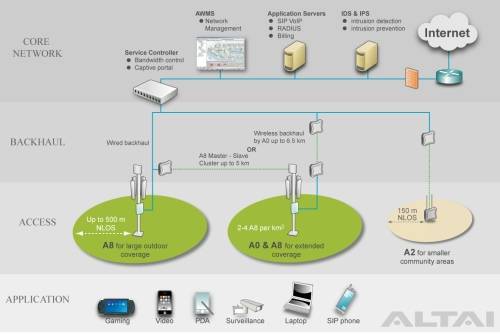
With special care to the urban WiFi application market, Altai can fully comply with and exceed all the expectations mentioned above. A typical installation scenario and the corresponding network components are described below:
This product is only sold through certified resellers and with ABP Technical support.
Contact ABP to learn more about Altai base stations.
Market Application Urban Network 500 KB



ABP Sec • ABP Tech • © 2012 ABP International, Inc • Phone: 972-831-1600