|
|
 |
Home > Solutions >
Enterprise Solutions > PBX Extension/Expansion
PBX Extension/Expansion
ABP Technology’s business partners can extend the functionality described in the previous section for the SOHO solution (such as IP phones, softphones, and the ability to work behind a firewall) to a small and medium enterprise (SME) environment by adding additional modular components.
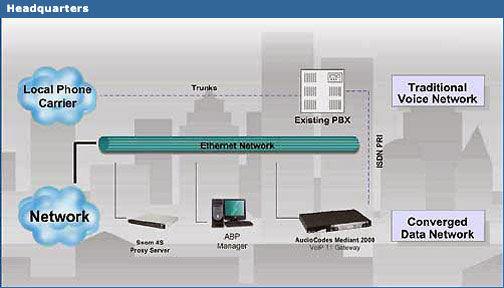
The first diagram shows the main location of a company.
There is a PBX that is connected to a voice over IP media
gateway.
The
gateway works in conjunction with the SIP Proxy Server
to convert traditional voice traffic to packets that can
be transported over a data network. The second diagram
illustrates a scenario in which IP telephony has been
added to an existing PBX for a SME.
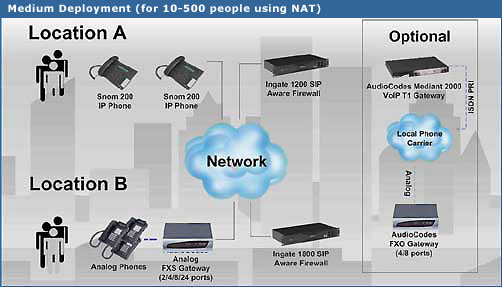
Scaling up to the SME solution from the SOHO solution will require a firewall
that supports a larger user base. ABP Technology offers
its partners a variety of firewalls from Ingate to meet
the needs of customers in this market segment. Location
A (40 users) has an Ingate 1200, whereas Location B (400
users) has an Ingate 1800. Ingate firewalls include everything
necessary for SIP traversal including a SIP registrar and
a SIP proxy to ensure dial tone if connectivity to the
main call manager were lost. They also support stateful
inspection, packet filtering, IPSec, and Transport Layer
Security for encrypted SIP sessions. Everything is configurable
through a web interface.
Optional trunking media gateways can be added to enable an organization to add
analog or digital trunks from the local service provider.
Also, analog FXS media gateways can be added for analog
phone support. This can be useful if your existing PBX
has run out of capacity and you do not need the advanced
functionality provided by IP phones. If your customer has
many remote locations of varying sizes, there are a variety
of gateways from which to choose (2,4,8,or 24 ports) to
help partners cost effectively deliver a solution tailored
to the customer’s needs. ABP Technology offers robust,
feature rich FXS and FXO gateways from AudioCodes that
support voice compression, fax over IP, and a variety of
open standards signaling protocols. Depending on the customer
that a reseller has, a hybrid implementation of IP phones
and analog phones might make sense.
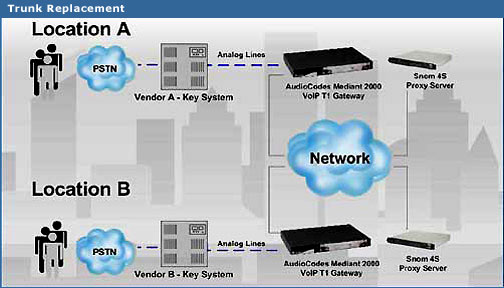
This diagram shows a trunk replacement scenario where a
low number of analog lines from small PBX systems at
remote
sites are connected to media gateways to support voice
over IP. The key system in Location A has 6 analog lines
from the local phone company to support 20 users. If
a large portion of calls are made by to and from employees
within the same company but in different sites (conference
calls, etc.), then 3 of the 6 lines could be routed to
a media gateway instead of terminating at the local phone
company. All of the intra-company traffic would automatically
be routed over the data network.
One key benefit for the customer is that now only 3 analog
trunks are needed from the local phone company instead
of 6, which results in a lower monthly recurring cost for
the customer. Another benefit is that more calls are now
able to pass between Location A and Location B since the
media gateways support compression and there is better
utilization of bandwidth. Also, by using the existing network
that currently supports email exchange and other data applications,
users are able to dial long distance calls without incurring
long distance charges.
This concept can be extended to international branch offices
as well. The components required for this scenario include
media gateways for the conversion of traditional
voice into data (such as the AudioCodes Mediant 2000),
an open standards SIP Proxy / Registrar, and spare trunking
ports on the existing key systems for connectivity to the
media gateways.
For more detailed product information
|
|
|